Speech & edge AI
Lightweight streaming models and model-to-hardware engineering for constrained devices.
Our technical foundation → FreunDo
Long-term future direction
Acoustic intelligence, beyond Earth.
Our future mission applicationsWe want to extend our Acoustic AI Agent into space research: helping people understand signals, monitor equipment, and make better-informed decisions. This is a research ambition, not a flight-qualified product.
The solar system, in sound
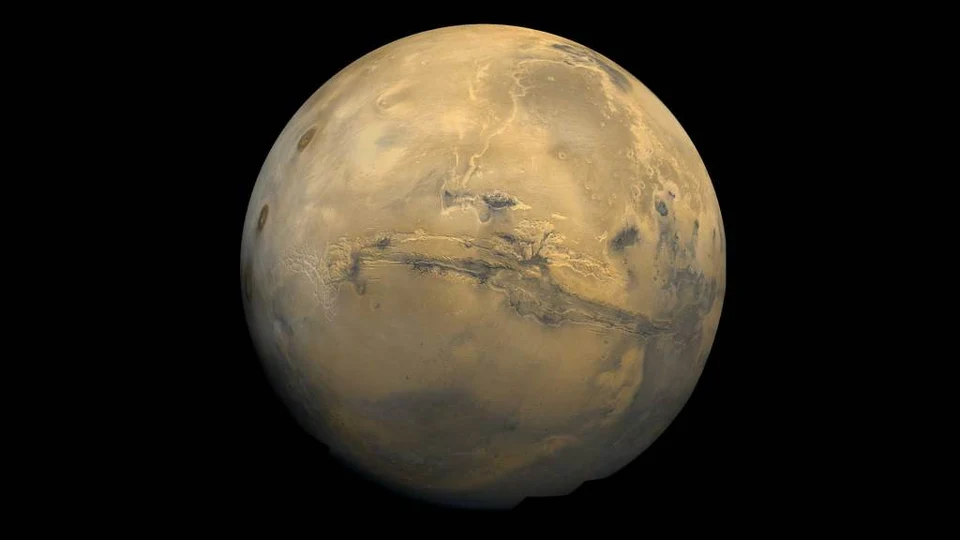
Recorded by Perseverance's SuperCam microphone on 22 February 2021. Wind is audible, especially around 20 seconds. Rover background noise was removed by the mission team.
NASA / JPL-Caltech / LANL / CNES / CNRS / ISAE-Supaero.
Audio sourceAudio could not be loaded. Try another planet or open the source above.
What are you hearing? Mars: a microphone. Earth, Jupiter, Saturn: audible mission measurements. Mercury, Venus, Uranus, Neptune: original data sonifications.
Ordinary sound needs a medium; it does not travel through a vacuum. Radio and plasma-wave instruments measure signals that can be made audible. These clips are not eight comparable recordings of planetary atmospheres.
Our four original 12-second sonifications use NASA orbital periods and diameters. Longer orbits map logarithmically to lower pitch and slower pulses. Diameter controls harmonic richness. These are designed educational mappings, not measured acoustic frequencies; the sonifications do not run our AI model.
u = ln(orbit / 88) / ln(59800 / 88)pitch = 880 × 2^(-3u) Hz; pulse = 2 - 1.5u Hzs = ln(diameter / 4879) / ln(142984 / 4879)
Second and third harmonics have amplitudes 0.4s and 0.2s relative to the fundamental. Fade-in and fade-out soften each clip.
Mars audio is resampled to 44.1 kHz, 16-bit mono for web playback. Other mission clips use the supplied MP3s. Playback volume is adjustable. Waveforms show peak amplitudes, normalised separately for display. Images are not to scale; some use mission colour processing.
NASA planetary data ↗All credits & sources ↓From listening to understanding
Our proposed role is to connect sensing, on-device analysis, and human review. Each environment needs its own data, validation, and safeguards.
Pressurised habitats
A future agent could compare equipment audio against operating baselines, flag unusual segments, and bring together recordings and maintenance context for an engineer.
An unusual sound is not a diagnosis. Validate against operating modes, sensor placement, and labelled faults; keep source recordings available for review.
Microphones or contact sensors capture fans and pumps alongside equipment state.
Compare against a baseline and group candidate events for review.
An engineer checks source clips and telemetry before any maintenance decision.
Mission data planner
One hour of continuous sensing
Selecting less audio leaves more data on board, but may omit useful context. Retain raw clips until a reviewed data policy permits deletion.
Planning arithmetic, not an AI benchmark. The selected fraction is your assumption, not a measured detection or compression rate.
16-bit, uncompressed PCM; continuous capture for one hour. Raw MB = channels × samples/second × 2 bytes × 3,600 / 1,000,000. Selected volume = raw volume × selected fraction. Average selected kbps = channels × samples/second × 16 × selected fraction / 1,000.
The downlink comparison assumes a link available for the full hour. It excludes packet overhead, metadata, error correction, contact windows, retransmissions, and competing traffic. Changing the sample rate changes captured bandwidth; choosing a low rate solely to reduce data may discard important signals. This planner does not estimate quality, power, or fault-detection accuracy.
Settings stay in this page. Email opens a draft for you to review; nothing is sent automatically.
Building toward the future
Our RFD speech-enhancement and FPGA co-design work is a starting point. Space applications would require new datasets, domain expertise, and mission-specific engineering.
Lightweight streaming models and model-to-hardware engineering for constrained devices.
Our technical foundation →Guided analysis, traceable evidence, and explanations that help people investigate a signal.
Meet the AI Agent direction →Representative acoustic tests, radiation and thermal qualification, reliable operation, and independent safety review before mission use.
Discuss research collaboration →Public mission material provides context for this educational explorer. It does not imply a partnership with or endorsement by NASA, JPL, or any mission team.
NASA planet image collection · NASA / NSSDCA planetary facts